This content has been prepared in compliance with the Medical Service Act and related laws.
After a severe ankle sprain, it's easy to think "it'll just get better with a few days of rest." However, the subsequent treatment direction changes completely depending on whether it's a simple strain, a partial ligament tear, or if there's tendon damage. X-ray is an examination that shows bones, so it cannot detect ligament or tendon damage, and this is where the role of ultrasound examination begins.
If you've sprained your ankle in Cheongju, here's why you should check ultrasound first
Ankle sprain is often lumped together as 'twisting,' but the degree of damage varies from simple strain to partial ligament tear, complete tear, and tendon damage. Even if you receive an X-ray result showing no fracture, if pain continues, you should consider the possibility of a problem in the soft tissue rather than bone.
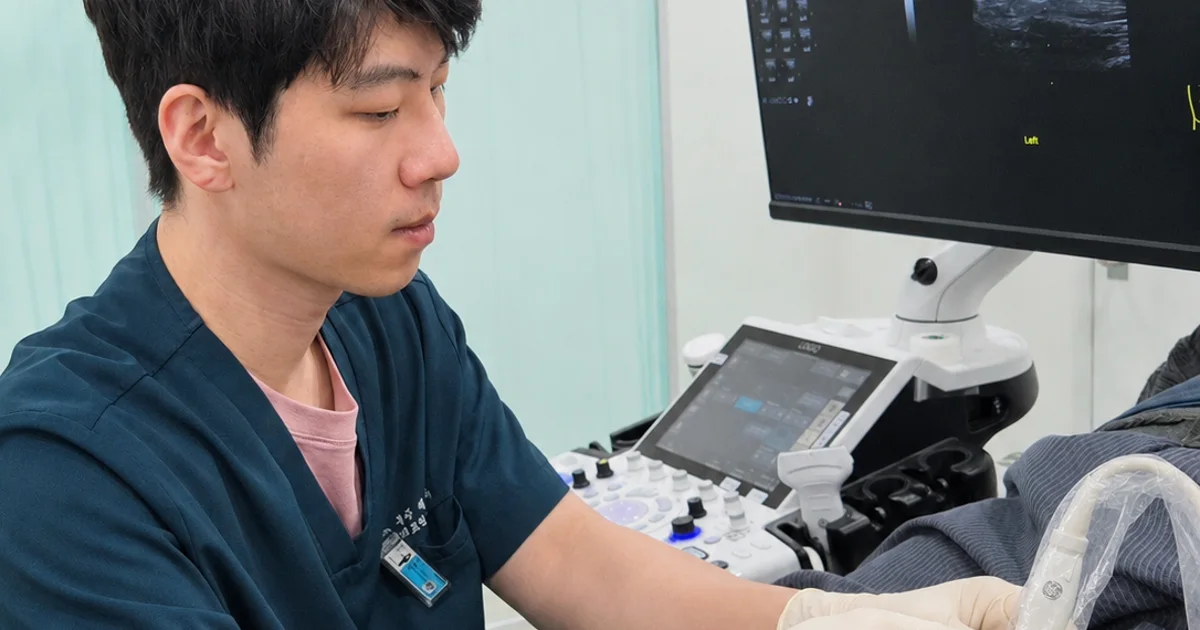
According to Korean Journal of Orthopedic Surgery 2023 data, ultrasound is useful for differentiating ligaments, tendons, and occult fractures in acute ankle injury, and in particular, it is possible to assess instability by performing dynamic examination while actually loading the ankle. If X-ray only shows the structure of bone, ultrasound confirms ligaments and tendons, which are soft tissues, in real-time.
However, there is one important point. Lesions that occur in deep areas of the joint, such as osteochondral damage or sinus tarsi syndrome, may be difficult to judge with ultrasound alone, and MRI additional review may be necessary depending on the situation. This is why it is important to consult sufficiently with medical staff after receiving ultrasound examination.
Q. I had an X-ray and it came back normal. Do I still need ultrasound?
X-ray is an examination to confirm whether there is a bone fracture. Many cases of ankle pain stem from soft tissue damage such as ligaments or tendons, and this area does not appear on X-ray. A normal X-ray finding does not mean 'there is no problem.'
What ankle ultrasound can detect — ligaments, tendons, and areas around bone
What can be confirmed when examining the ankle with ultrasound? I've organized it by frequently damaged structures.
| Structure to be confirmed | What ultrasound can show | Reference |
|---|---|---|
| Anterior talofibular ligament (ATFL) | Presence of tear, extent of tear | Diagnostic accuracy 90–100% |
| Calcaneofibular ligament (CFL) | Presence of tear, thickening, degeneration | Diagnostic accuracy 87–92% |
| Peroneal tendon | Tear, dislocation, sheath effusion | Dynamic examination can confirm dislocation |
| Achilles tendon | Partial tear, tendinitis, calcification | Real-time structural confirmation |
| Soft tissue around bone | Hematoma, swelling, joint fluid | Non-confirmable by X-ray |
According to Korean Journal of Orthopedic Surgery 2019 data, the diagnostic accuracy of anterior talofibular ligament tear using ultrasound is 90–100%, and calcaneofibular ligament is 87–92%. Furthermore, in a Korean Journal of Radiology meta-analysis (695 subjects, 15 studies), the sensitivity of ultrasound in diagnosing chronic anterior talofibular ligament injury was 0.99, exceeding MRI (0.83).
Ultrasound has lower cost burden than MRI, and the ability to confirm instability in real-time while actually moving the ankle is also an important advantage. However, ultrasound examination can result in differences in result interpretation depending on the proficiency of the medical staff performing it. This is why it is important to receive the examination from medical staff with extensive experience in musculoskeletal ultrasound.
What makes ankle ultrasound different at Asanwell
In ankle ultrasound examination, 'who performs it' directly affects the result interpretation.
Asanwell pain clinic's ankle ultrasound procedure is as follows:
— Performed directly by specialist: Dr. Young-moo Kim, the representative director, is an anesthesiology and pain medicine specialist with a subspecialty in pain medicine from Asan Medical Center and holds APCA RMSK (American Musculoskeletal Ultrasound Certification), directly performs the ultrasound, and when damage findings are confirmed, ultrasound-guided injection therapy can be coordinated on the same day.
— What is RMSK certification: According to Inteleos official guidance, APCA RMSK is an international physician certification requiring at least 150 cases of clinical musculoskeletal ultrasound experience within 36 months and passing the certification exam. There are not many medical staff in Korea who have obtained this certification.
— Immediate coordination of abnormal findings: If ligament damage is confirmed on ultrasound, ultrasound-guided injection therapy can be coordinated on the same day, allowing progression without unnecessary waiting between diagnosis and treatment.
— Dynamic examination possible: The ankle is actually moved to confirm ligament instability in real-time. According to Korean Journal of Orthopedic Surgery 2025 data, the clinical application effectiveness of ultrasound-guided injection therapy for foot and ankle has been confirmed.
— Simultaneous differentiation of musculoskeletal and venous conditions: Some ankle pain may be related to vascular issues. When necessary, a medical care environment equipped to differentiate venous disease as well is in place.
Should I get ankle ultrasound right now? — 5 things to check yourself
Check the following items yourself. The more items that apply, the better it is to prioritize ultrasound examination.
— Bruising spreads widely or swelling is severe immediately after the sprain
There is a possibility of damage beyond a simple strain.
— Even after 48 hours, the pain has not subsided
If it's just a sprain, pain often gradually improves after the initial 2–3 days. If pain persists, it is necessary to confirm structural damage.
— The ankle feels shaky when walking or you have a sensation of it 'giving out'
It may be a sign of instability due to ligament tear. According to Korean Journal of Rehabilitation Medicine data, musculoskeletal ultrasound can differentiate and evaluate partial tear and complete tear of lateral ligaments in stages.
— You've had multiple sprains and the same area repeatedly hurts
It may have progressed to chronic instability. Even after the acute phase has passed, ultrasound is effective in confirming the state of ligament degeneration, thickening, and chronic damage.
— You had an X-ray, but did not confirm the condition of the ligaments or tendons
A result of no bone abnormalities alone cannot confirm whether there is soft tissue damage. According to related clinical data, approaches to identify the damaged site precisely with ultrasound and induce tissue recovery through non-surgical injection therapy are being utilized.
Caution: If sinus tarsi syndrome or osteochondral damage affecting deep areas of the joint is suspected, ultrasound examination alone may have limitations in diagnosis, and it may be appropriate to perform MRI examination concurrently. Consult with medical staff and determine the direction of examination.
Residents of Sachik-dong, Bunpyeong-dong in Cheongju and nearby areas in Ochang, Osong, and Chungju can also visit Asanwell pain clinic.
Once you properly address your ankle, it makes a difference for life
We recommend that you visit Asanwell pain clinic in Seowon-gu, Cheongju to accurately assess the condition of your ankle through musculoskeletal ultrasound with an RMSK-certified director.
Many cases of ankle sprain being overlooked as 'it will get better with time' progress to chronic instability or joint damage. According to Korean Journal of Orthopedic Surgery data, the possibility of chronicity increases if proper treatment is not received early. On the other hand, if the damaged structure is identified precisely with ultrasound and non-surgical treatment (ultrasound-guided injection therapy, shock wave therapy, etc.) is started in time, functional recovery can be expected in many cases without surgery.
Once the ankle develops chronic instability, it affects virtually every movement in daily life. One accurate ultrasound diagnosis can change the entire subsequent treatment direction. We encourage you to check the condition of your currently uncomfortable ankle properly, once and for all.
After ankle sprain, ultrasound — actually, these are the things you were curious about, right?
Q1. The X-ray said it was normal, but do I still need to get ultrasound separately?
X-ray only confirms whether there is a bone fracture. The considerable cause of ankle pain, ligament tear and tendon damage, does not appear on X-ray. A normal X-ray finding does not mean 'there is also no problem with soft tissue,' so if pain persists, it is recommended to separately confirm ligaments and tendons with ultrasound.
Q2. How long does an ankle ultrasound take, and is it very painful?
Musculoskeletal ultrasound is performed by applying gel on the skin and gently placing a transducer, with virtually no pain. The examination time varies depending on the site and condition, but typically takes about 10–20 minutes, and no special preparation or fasting is necessary, so you can receive it immediately on the same day.
Q3. If ultrasound confirms a ligament tear, do I need surgery right away?
Even if a ligament tear is confirmed, surgery is not immediately necessary. Depending on the degree of damage, non-surgical treatment such as ultrasound-guided injection therapy or shock wave therapy is often attempted first. Whether to have surgery is decided after comprehensive consideration of tear extent, degree of instability, daily activity level, etc., in consultation with medical staff.
Q4. It's been several days since the sprain; is there still meaning to getting ultrasound now?
Yes, it is definitely meaningful. Even after the acute phase, ultrasound is effective in confirming ligament degeneration, thickening, partial tear traces, and whether there is chronic instability. In fact, you may be able to see the ligament structure more clearly after the initial swelling subsides.
Q5. Besides the ankle, can other areas (knee, shoulder, wrist, etc.) pain also be checked?
Musculoskeletal ultrasound can be applied not only to the ankle but also to various areas such as the knee, shoulder, elbow, wrist, and fingers. If you have pain in multiple areas, please mention them when you visit, and we can check the necessary areas through consultation.
Non-covered medical care fees are posted and guided within the clinic in accordance with Article 45 of the Medical Service Act.