This content has been prepared in compliance with relevant laws including the Medical Service Act.
Extracorporeal Shock Wave Therapy Near Sannam-dong: Can You Resume Daily Life on the Day of Treatment?
To answer directly, light daily activities are possible immediately after the procedure. However, it is a general principle to avoid activities that place burden on the treatment area within 48 hours after the procedure.
According to patient education materials from Washington University Orthopedics, it is recommended to stabilize the treatment area immediately after the procedure and avoid activities that may stress the area for 48 hours afterward. General walking or light office work can resume the same day, but intense exercise, lifting heavy objects, or high-impact activities should be approached carefully as they may diminish treatment effectiveness.
However, recovery time varies individually depending on the pain location and intensity, and underlying health status. It is safest to confirm in advance with your attending medical professional how much activity is possible on the day of the procedure.
How Does Extracorporeal Shock Wave Therapy Reduce Pain?
Shock wave therapy is not merely a pain relief treatment. It is a non-surgical therapy that delivers high-energy waves to damaged tissue to reactivate the body's own self-healing and regeneration process.
According to clinical data, extracorporeal shock waves work by generating new microvessels, promoting regenerative cascade reactions in damaged tissue, and reducing neurotransmitters that cause pain. It is primarily applied to chronic tendon diseases such as plantar fasciitis, calcific tendinitis of the shoulder, tennis and golf elbow, and Achilles tendinitis. Domestic and international orthopedic clinical guidelines recommend shock wave therapy as a non-surgical option before surgery in cases where conservative treatment for 4–6 weeks shows no improvement.
In particular, tendons are hypoxic tissues with limited vascular distribution, and when repetitive microscopic damage accumulates, the natural healing rate often cannot keep pace with the progression of the lesion. Shock waves have evidence for breaking this deadlock, and they are more suitable for subacute and chronic injuries than acute injuries.
A frequently asked question — "Is shock wave therapy surgery?"
— No. It is a non-surgical treatment that does not involve skin incisions, and the procedure is performed on an outpatient basis without anesthesia.
Asanwell pain clinic's Approach to Shock Wave Therapy
Shock wave therapy does not guarantee effectiveness simply by having the equipment. The choice of equipment matched to the location and depth of the lesion, and accurate assessment of indications, determine treatment results.
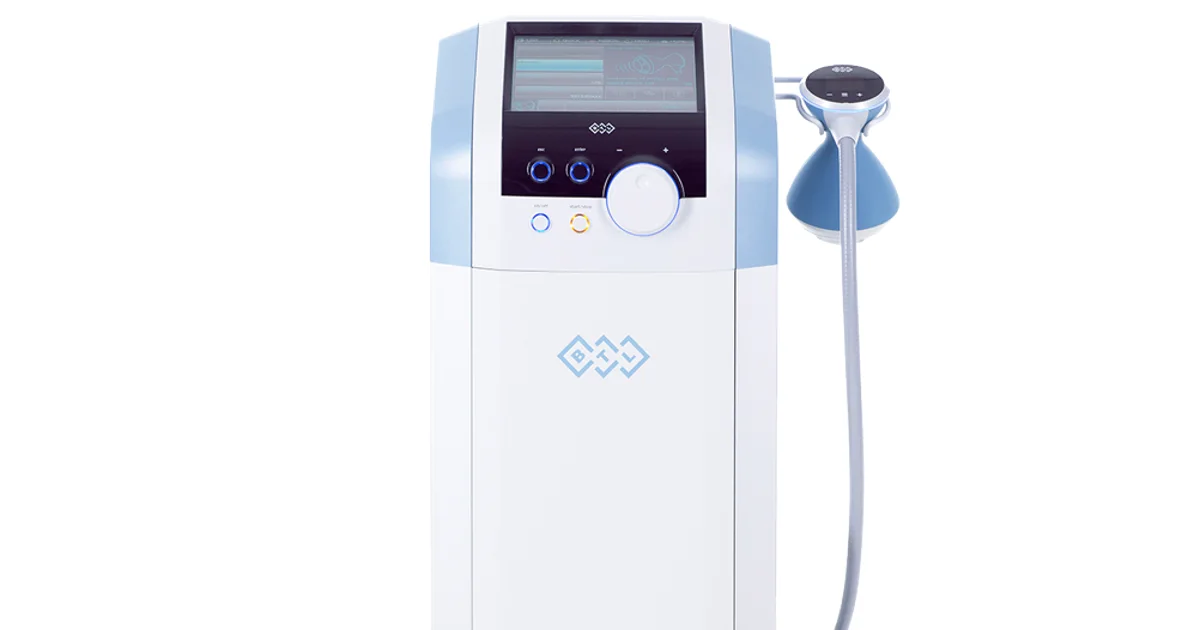
According to clinical data, focused equipment concentrates energy at a single point and is suitable for deep lesions at 3–12 cm depth, while radial equipment disperses energy widely and is mainly used for superficial tendon treatment. Even for the same plantar fasciitis, the choice of equipment and treatment intensity must vary depending on the lesion location and patient status to be effective.
At Asanwell pain clinic, the director, a specialist in anesthesiology and pain medicine with subspecialty training in pain medicine at Seoul Asan Medical Center and holding ISMST-ICC International Extracorporeal Shock Wave Certification, directly judges indications and prescribes treatment. The procedure is performed after confirming the exact location of the lesion under ultrasound guidance, so you can confirm everything from diagnosis to procedure and aftercare instructions in a single visit.
| Distinction | Focused | Radial |
|---|---|---|
| Energy Delivery Method | Concentrated at one point | Dispersed widely |
| Suitable Lesion Depth | 3–12 cm (deep) | Superficial tendons |
| Primary Applications | Calcific tendinitis, deep plantar fascia | Achilles tendon, superficial tendons |
| Ultrasound Guidance | As needed | As needed |
It is easily accessible for residents near Sannam-dong and Bunyeong-dong.
Before Shock Wave Therapy, Check If You Fall Into These Categories
Shock wave therapy can be safely applied to most chronic tendon diseases, but those fitting the following should definitely consult with a medical professional before the procedure:
— Those who are pregnant
— Those with acute inflammation in the treatment area
— Those with bleeding disorders or taking anticoagulants
— Those with tumors in or near the treatment area
Beyond this, if you have diabetes or are smoking, clinical data indicates that tissue regeneration speed can slow significantly. Blood sugar control and smoking cessation are important prerequisites for enhancing shock wave therapy effectiveness. Additionally, if the treatment area is specified without accurate diagnosis, effectiveness can be halved, so it is a priority to first confirm indications through ultrasound examination before the procedure.
According to Hidoc Health Q&A data, a temporary worsening of pain may occur 1–3 days after the procedure, which is a normal response occurring as shock waves trigger healing reactions in tissue. If you are concerned about sudden pain worsening, it is good to receive guidance in advance before the procedure.
Shock wave therapy near Bunyeong-dong, Extracorporeal shock wave in Seowon-gu, Cheongju, Pain treatment in Bokdae-dong — residents of nearby areas can also visit after having a preliminary ultrasound diagnosis and confirming indications.
Do You Have Questions About Shock Wave Therapy? Feel Free to Ask
At Asanwell pain clinic, you can confirm everything from ultrasound-guided diagnosis through shock wave procedure to recovery precautions in one visit. Shock waves typically achieve stable tissue regeneration when received consistently 3–5 or more times at weekly intervals. If you stop after 1–2 sessions because pain has decreased, re-inflammation can occur in not-yet-fully-healed tissue, so it is important to continue treatment at the scheduled intervals.
Residents near Sannam-dong and Bunyeong-dong can also receive immediate consultation and procedure on the same day. If you have any questions before treatment, please feel free to visit and ask. We will review the situation together and find the right direction for you.
Before Shock Wave Therapy, These Are Frequently Asked Questions
Q1. Is it okay to drive on the day of shock wave therapy?
Since shock wave therapy proceeds without anesthesia, driving itself is often possible immediately after the procedure. However, temporary discomfort may remain in the treatment area, so it is better to drive short distances rather than long distances and avoid strained movements on the day of treatment. Outcomes can vary by individual condition, so confirm with your medical professional after the procedure.
Q2. How many days after treatment can I resume exercise?
Light walking and everyday-level movements are possible the same day, but impact-bearing exercise such as running, weight training, and ball sports are recommended to resume gradually 48–72 hours or more after the procedure. The timeframe varies depending on the treatment area and symptom severity, so please consult with your attending director before deciding.
Q3. How many sessions of shock wave therapy are needed for results?
Generally, 3–5 or more sessions at weekly intervals are needed for tissue regeneration effects to reach stable progression. Even if pain subsides after 1–2 sessions, tissue may not be completely recovered, so it is important to complete the prescribed number of treatments. The exact number is determined after diagnosis.
Q4. Is it normal for the treatment area to hurt more after therapy?
It is a normal response. As shock waves trigger healing reactions in damaged tissue, pain may temporarily worsen, typically most noticeable 1–3 days after the procedure. Subsequently, pain often shows gradual improvement. If pain is severe or persists beyond 3 days, inform your medical professional.
Q5. Besides plantar fasciitis and calcific tendinitis, are there other conditions that benefit from shock wave therapy?
Yes, the range of applications is quite wide. It is widely used for chronic tendon diseases such as Achilles tendinitis, tennis and golf elbow, knee patellar tendinitis, and rotator cuff tendinopathy. It can also be applied in some cases of myofascial pain syndrome (muscle tightness and trigger points). Whether a particular condition is suitable is determined after diagnosis.
⚠️ The possibility of procedure side effects may vary depending on individual skin condition.